![]()
![]()

TREBORWOLF'S Friendly
American Strain of Drahthaar
SEPARATING
FACTS FROM FICTION
Are German Wirehaired Pointers and Deutsch Drahthaars the same breed? This is an honest question asked by the novice dog buyer seeking to learn more about his next hunting breed. The answer is unquestionably – YES. In fact, the word “Deutsch” means “German” and “Draht” means “Wire”; and “haar” means “hair”. Thus, Deutsch Drahthaar is German Wirehair. Nevertheless, an American VDD representative, proclaiming to be an expert, created this mythology about two distinct breeds. It is difficult for some individuals to accept the fact that there is only one breed. Belonging to a particular organization, is not a guarantee that you own a better or a worse dog. VDD dogs tested by NAVHDA have achieved no better or worse scores than their American counterparts. The DNA that flows through their bodies is one in the same. The dogs do not differ in DNA; they are not different breeds. Are there differences between individual dogs? The answer is yes. True difference are usually between breeders and not which organization that you register your dog with. This is where the ‘Strain” or “Line” plays a significant role when selecting a pup. Eventually, a kennel's reputation is reflective of it’s particular traits.
HOW A DOG IS USED
The use of the dog predicates the
breeder to emphasize certain characteristics or traits that he as a breeder and
possibly hunter desires to establish within his line or strain. Regardless of
the registry, the dogs possess the same genes. However, one may use a dog quite
differently in
The Wirehairs are all the same breed of dog. They are not two distinct and separate breeds. Their utilization may be profoundly different. The method of training also varies as well as how the breeder emphasizes what he wants to establish in his progeny. A dog that hunts large game or vermin may at times need to defend himself. Some breeders desire a dog that has a high measure of the “instinct to kill.” Dog breeds such as the "Pit Bull" possess a high "instinct to kill". Such dogs display a trait of “sharpness” or “aggression”. There are many stories of German breeders who participated in events that tested the aggression factor of their dogs. These trialers dug a hole, covered it with planks, and further covered it with dirt. An assistant released a Badger from its cage into this hole. Each handler brought his dog to this spot to test the dog’s ferocity and instinct to kill. It was not a matter of whether the dog could dispatch the Badger, but how many seconds it took to kill it. Two of the highly toted breeds were the Jadgterrier and the Drahthaar. Some Drahthaar breeders believe that a dog that has a high “instinct to kill” will never refuse a command; no matter how difficult. The aggression test is a part of the VDD testing.
THE AMERICAN HUNTER
In
Through selective breeding, the breeder can
emphasize or de-emphasize certain genetic traits. A breeder has a
responsibility to learn about genetics. He controls the selection of
mates. Breeding “like to like” can be a good practice, especially when trying
to improve upon a certain quality. Show breeders may over emphasize their
desire for a certain look. If they do so at the loss of performance then the
progeny of their future generations will most likely suffer. The American
purchasing public does not want aggressive dogs or dogs used primarily after
the shot. It is up to the breeders’ to design a program that emphasizes the
desired traits that most people want.
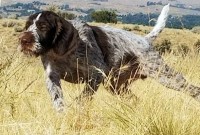
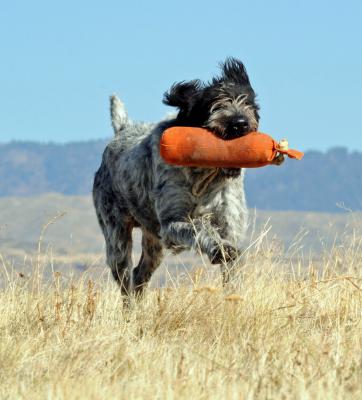
At TREBORWOLF Kennels, almost the entire line is of German ancestry. One goal was to purchase Wirehairs that descended from the Poodle & Griffon ancestry. A difficult search proceeded to locate German kennels that produced individual dogs that emphasized the desired traits. After 36 years and countless work, TREBORWOLF KENNELS produces one of the finest lineage of gundogs that money can buy. Personality and temperament are two attributes of highest concern. An integral part of this formula is to breed the "smart" ones. Next is the dog’s ability to search and find game. A Wirehair should maintain a regulated and thorough pace. He should quarter naturally and pattern, within a range from 20 to 60 yards. Nose quality is very important. It is far better to have a 200-yard nose than a 200-yard range. Once the Drahthaar has located the quarry, he should hold the prey via a staunch point. A Drahthaar that lacks the intensity to hold point or has a greater tendency to “catch and kill” the quarry will inevitably bust the game. Next, the Drahthaar should have a strong "instinct to carry". Drahthaars that inherit an abundant resource of this natural instinct require little training, and very seldom lose any game. There is no need to “force train” a well-bred Wirehair to retrieve. Force-training methods developed primarily to teach dogs to retrieve, that lacked the natural instinct. It is rare to loose game while hunting over a TREBORWOLF Drahthaar.
![]()
Home page | Treborwolf Dogs | Photos | Warranty | Grading System | Order Form | Products | References | Schwarzschimmel
![]()
Pointing | Honoring | Retrieving | Waterwork | Broke To Wing &Shot | Black& White Issue
|
![]()
Customers-Competition| Customers-Pets| Customers-Hunting | Customers-Post Hunt| Customers-Pups
![]()
TREBORWOLF
KENNELS
1-208-713-8400